Policy Manual Changes: What does it mean for adjustment of status and green cards? (PM-602-199)
Last Update 06/05/2026
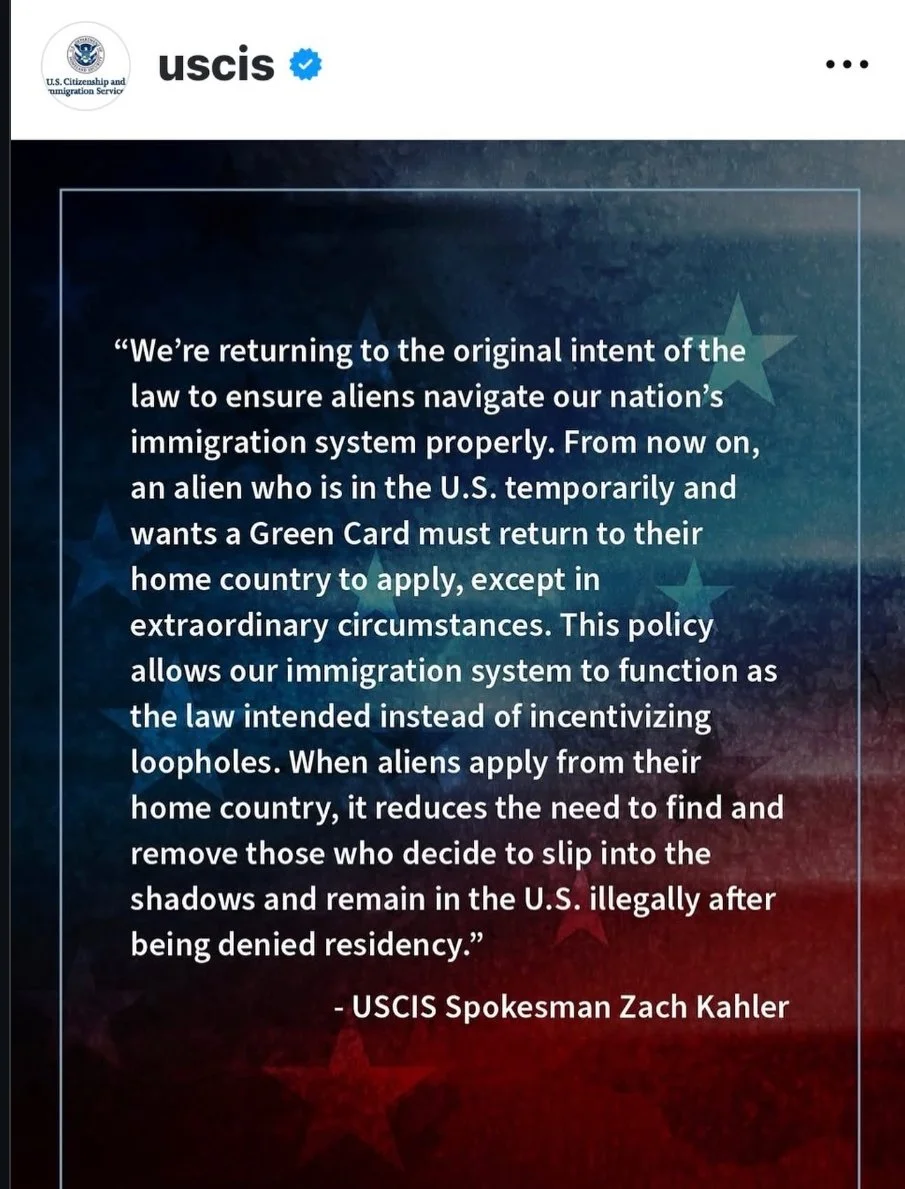
On a Friday before a long holiday weekend, the U.S. Citizenship and Immigration Services (USCIS)released a memo, Policy Manual PM-602-199, characterizing adjustment of status as “a matter of discretion and administrative grace, and an extraordinary relief.” What does it mean for people seeking a green card? What Does it mean to adjust status? Does it mean you have to leave? Find out the details relevant to you and what you can do to be prepared.
What is Adjustment of Status (AOS)?
Adjustment of status, is the act of asking the government to be approved of a green card from inside the United States, without having to leave. A green card, also known as an I-551 document, can be used to demonstrate that you are living in the United States with permision. Since the creation of the Immigration and Nationality Act (INA) of 1952, the processes of applying for a green card without leaving the United States have been protected. For example, say a model from the Czech Republic enters the U.S. on a short-term business visa, meets an American, falls in love, and marries him. She could apply for an adjustment of status to obtain a green card and eventually become a naturalized U.S. citizen.
What the New USCIS Memo Says About Adjustment of Status
While the USCIS memo focuses on the discretionary nature of an AOS decision, we do not believe that means that immigrants seeking AOS should lose hope. The fact is that federal law, federal immigration regulations, and more than half a century of case law have established that the totality of the circumstances must be considered in each individual case. That has always been the case and will continue to be.
As the memo itself states, “adjudicators must weigh all positive and negative factors, including family ties, immigration status and history, the applicant’s moral character, and any other relevant factor that bears on determining whether the alien warrants a favorable exercise of discretion.”
The Board of Immigration Appeals in 1970 stated that “favorable factors such as family ties, hardship, length of residence in the U.S., etc. will be considered as countervailing factors meriting a favorable exercise of administrative discretion. In the absence of adverse factors, adjustment will ordinarily be granted, still as a matter of discretion.” Matter of Arai, 13 I.&N. Dec. 494 (BIA 1970).
No memo can overrule Board precedent.
Across the board, we have experience that when a UCSIS officer reviews our cases and meets our clients, they agree that the favors weigh in favor of granting a green card. Now the considerations may shift, be given different weight, or deepen; still, when an applicant can demonstrate solid employment, education, family ties, children, community, and are able to contribute to the values of the community and economy, then these factors are in line with the core legislative purposes that the adjustment of status was built upon and echoed in the very Policy Manual of USCIS.
What Do I Do If My Case is Still Pending?
Like cases not yet filed, pending cases are subject to the new consideration of the PM-602-199. Only cases that have been already approved for their green card will not be effected by PM-602-199. This means that shifting from one green card status to another green card status or the first time they are seeking a green card will be under the consideration of PM-602-199, the new USCIS policy.
We are seeing, nationally, pending cases get request for additional evidence to meet this policy manual standard. Whether we wish to or not, cases are already being effected.
At this office, we are preparing for this by ensuring that our pending cases are well prepared and addressing this new level of scruitiny. We are currently reaching out to clients to formulate strategies in advance of the RFE and interview, whether to prepare in advance to allow for more frictionless process or wait, gather more information, and act, under limited time, when we must. At the firm, it is our core belief to ensure that our clients, communities, and people whom we’ve made promises to are protected through an ever changing landscape.
Experienced Legal Representation Matters in Adjustment of Status Cases
What the USCIS memo does make clear is that it has never been more important to have a skilled and experienced immigration attorney at your side if you are seeking an AOS. Future filings will ensure that we address this new standard so that the intending immigrant is best positioned for success. We know that having preperation with a qualified lawyer, one who is dedicated and willing to negotiate on your behalf, you can ensure the best possible chance for your case.
Kenneth, along with the firm, is monitoring this case alongside other firms on a national level, as well as staying up to date with events and information so that we can handle this new change with client’s safety and success in mind.
Updated on 06/05/2026
Trump has recently shared that not everyone has to leave the country, and that is in alignment with what we are seeing on a national level: that everyone has their burden of proof to demonstrate their own right to stay in the United States for their green card process. At this time, tech companies are lobbying for this change, however, no change has been made yet that this administration expects intending green card holders to defend themselves - we are still seeing RFE’s and interview questions supporting this.
(Deep thank you and credit to the team at: https://bprimmigration.com/blog/dont-panic-about-the-uscis-memo/)